
The making of Persian rugs of extraordinary quality reached its peak during the Safavid Empire. The rulers of this dynasty were passionate lovers of the arts. The court itself sponsored several fields of art, including the weaving of carpets for use in its own palaces. It was during this period that the finest carpets in history were made by the most skilled artists and masters. It was the combination of unsurpassed creativity and skill with the use of the finest materials that gave rise to what became known as the First Golden Age of Persian Carpets.
The Safavid Empire (1501-1722), founded by Shah Esma’il I, swiftly conquered territories including Persia, Armenia, the Caucasus, Turkestan, and Afghanistan.
Below is the famous Persian miniature depicting the legendary hero Rustam (Rostam), one of the rich illustrations of the epic Shahnameh (The Book of Kings). This work was produced by the renowned art school of Tabriz around the period between 1530 and 1535. The illumination shows the classic traits of the Safavid period, with highly stylised rocky mountains, gold applied to the background, meticulous detailing of the vegetation and the horses, and calligraphy in Nasta’liq script along the upper margins.
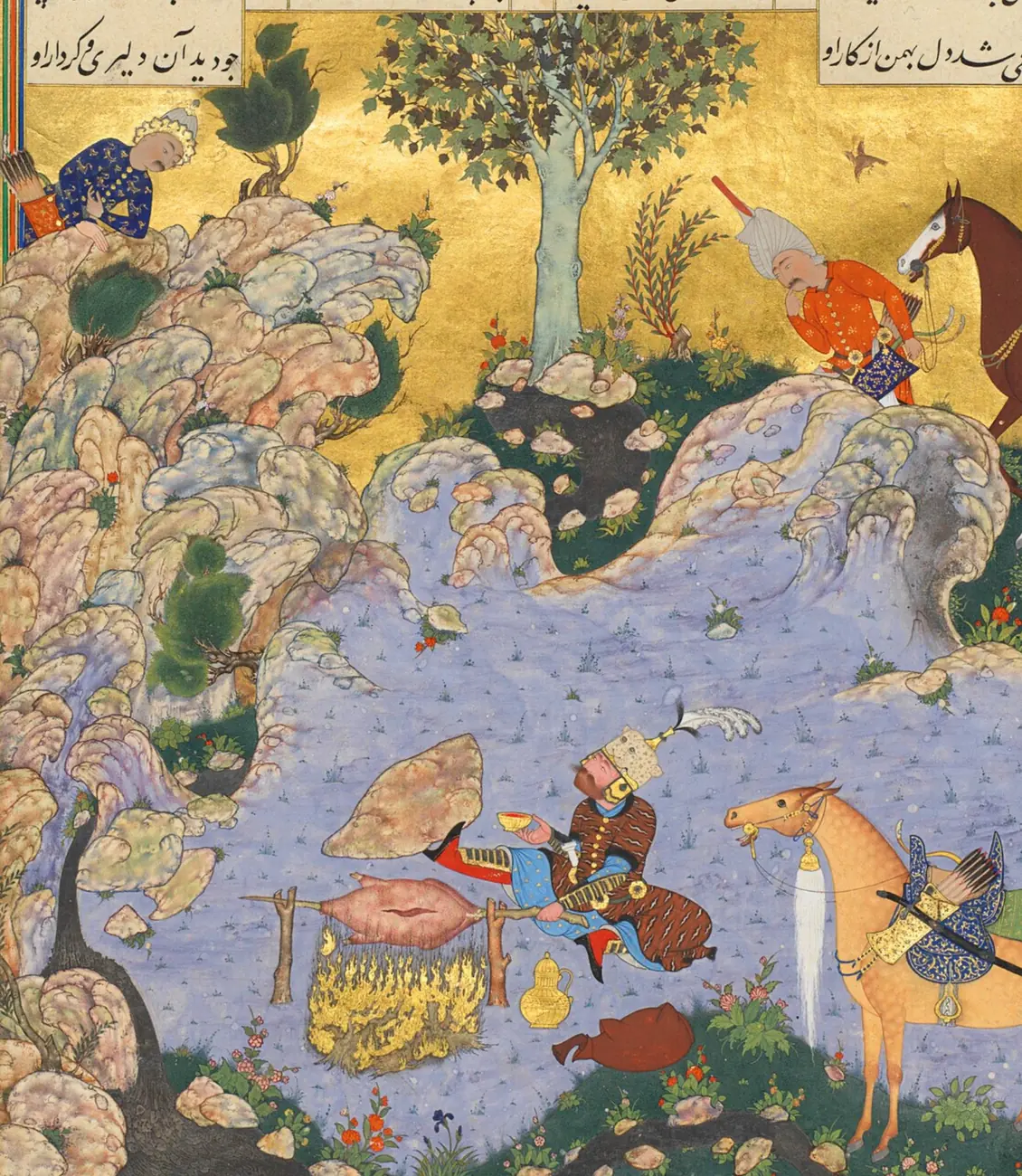
The Safavids, deeply interested in arts, established schools in Tabriz and later in Isfahan under Shah Abbas. These schools taught ceramics, tile work, miniature painting, metal arts, silk brocade, velvet making, book arts, illuminations, manuscript illustrations, and carpet weaving.
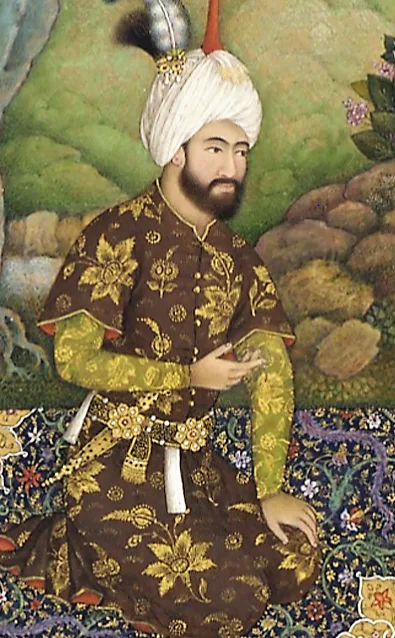
Three Safavid rulers significantly contributed to this period: Shah Esma’il (r. 1502-1524), his son Shah Tahmasp I (r. 1524-1576), and his grandson, Shah Abbas I (r. 1587-1629). Shah Tahmasp sponsored illuminated manuscripts, the most notable being the illuminations of the Shahnameh or Epic of Kings, written by Persian poet Ferdosi (940-1020). The illuminations by artist Aqa Mirak inspired many carpet designs during his reign. The world-renowned Ardebil carpet, now in the Victoria & Albert Museum in London, was made during Shah Tahmasp I’s reign.
The image below depicts a carpet with hunting scenes and banquets, reflecting Safavid court life. The rug’s palatial size, superior silk material, and exquisite finish suggest it was made for Shah Tahmasp I. The rich pictorial patterns are believed to be the work of leading Safavid court painters, Aqa Mirak and Sultan Muhammad. The central medallion, adorned with metallic threads, depicts a battle between dragons and the phoenix, a motif showing Chinese influence in Persian art. The field’s flowering vines feature hunters pursuing rabbits, deer, antelopes, and lions. The border design’s relaxed atmosphere contrasts with the dynamic center, with elegantly attired courtiers discussing the day’s hunting adventures over food and drink.
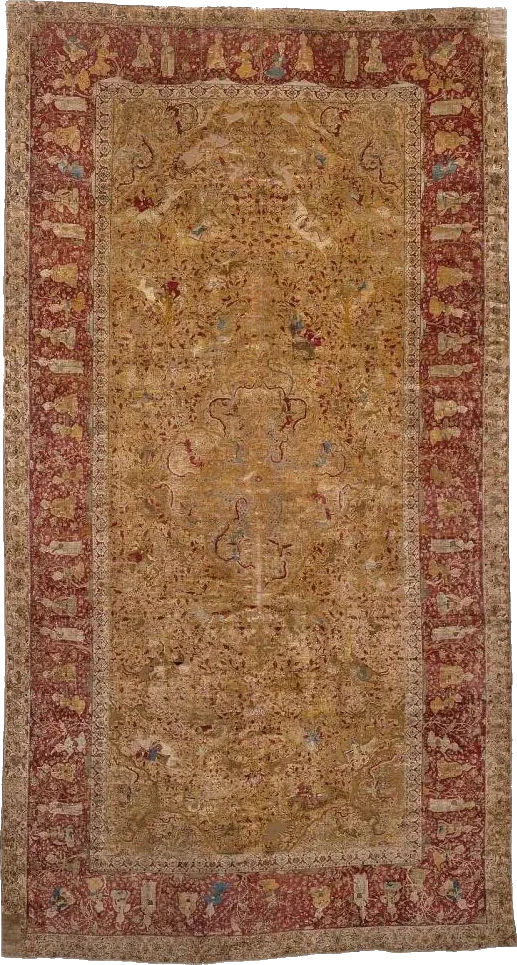
Hunting rug made for Shah Tahmasp I around 1530. Property of the Museum of Fine Arts, Boston.
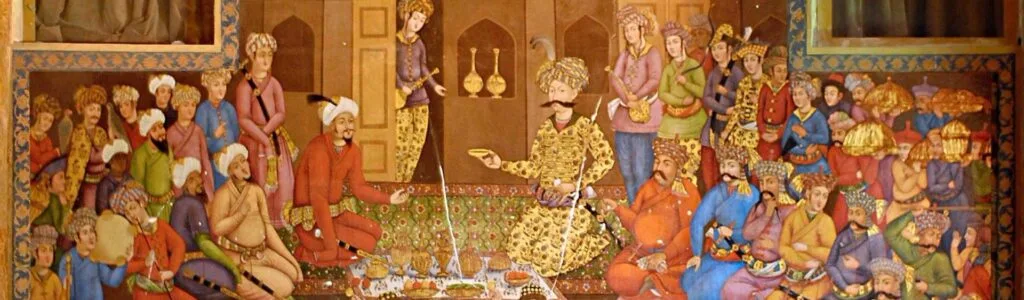
In the late 16th century, Shah Abbas I relocated the Safavid Dynasty’s capital to Isfahan, transforming it into an architectural masterpiece and the empire’s crown jewel. Isfahan, a city of gardens, squares, palaces, mosques, and bazaars, was so beautiful it was dubbed ‘Esfahan nesfe-e jahan’ (Isfahan is half the world).
During the 17th century, European clients sought Persian carpets with Polonaise, Vase, and Herat-Isfahan designs. The majority of orders were for Polonaise design rugs made with pastel and neutral colors and lavish motifs in silk and metallic threads. Many European noble carpets bearing the royal family emblem were ordered directly from the Isfahan workshops. The Safavids achieved an unparalleled balance between the composition and execution of carpet art by requiring their most talented artists to fully commit to design creation.
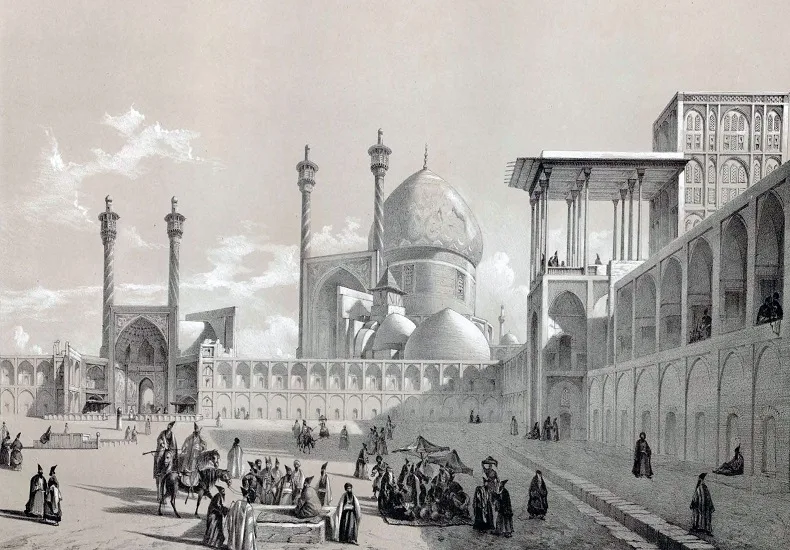
Carpets from the First Golden Age of Persian Carpets revolutionized carpet production in Persia and other regions under Persian Empire influence.
The best-known design created during the Safavid Dynasty is the Shah Abbas pattern, which consists of large palm leaves, vines and small flower buds woven into the main field of the carpet and along its borders. At times this style also includes arabesques, clouds and stylised animals. Most often the Shah Abbas design covers the entire field of the carpet, but it may also appear around a medallion.
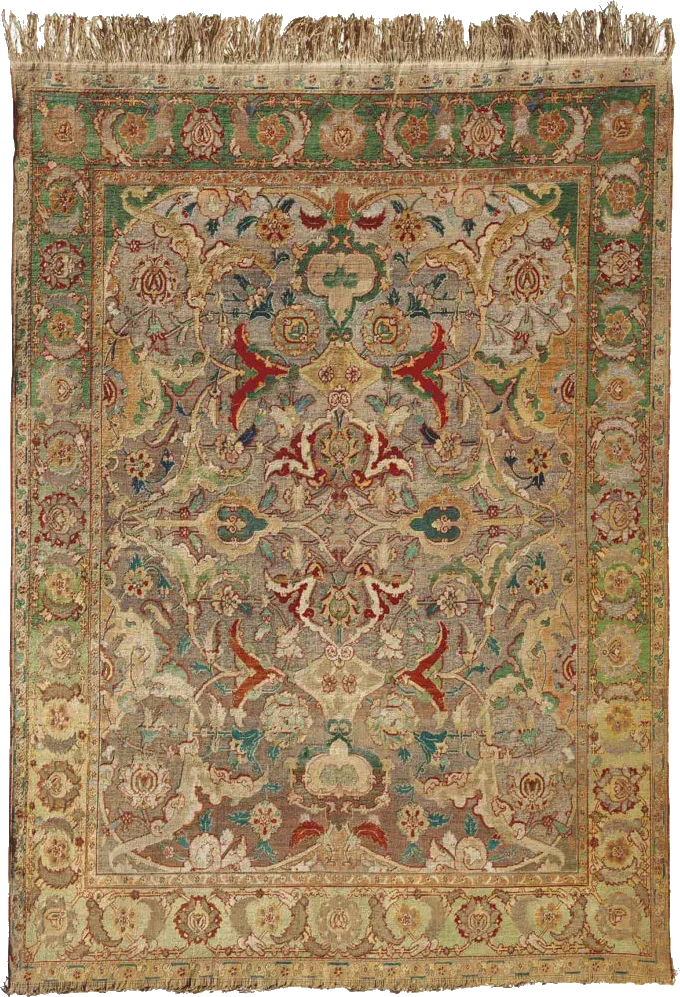
The Shah Abbas design, made of palm leaves, became one of the most widely used motifs. It represents the Persian Empire and everything it encompassed. It is a floral design found in many carpets produced at that time, and today it is still incorporated into Persian rug designs. You may also find it in carpet designs from other countries, but in that context the motif has lost its original meaning and its connection with the reign of Shah Abbas.
It is worth noting that, although the design represents Shah Abbas and his dynasty, it has taken on many different forms. There are regional variations, and it is clear that some artists altered this motif to produce new versions. The Shah Abbas design is frequently found in rugs from Isfahan, Kashan, Mashad, Nain and Tabriz.
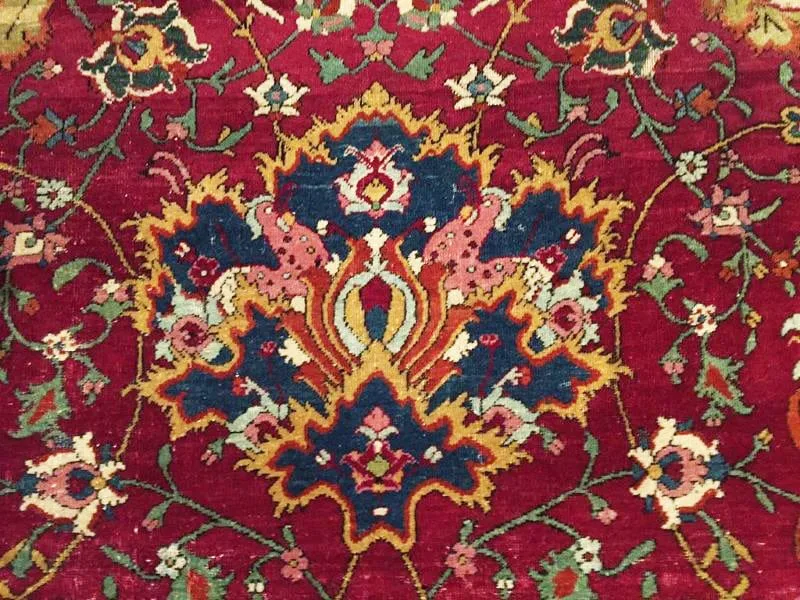
Alongside the Shah Abbas design, other figures like the lotus flower and peony flowers may appear in a carpet’s design. Distinguishing the Shah Abbas palm leaves from a peony or lotus flower can be challenging due to their artistic complexity. This design is prevalent in carpets from India, Pakistan, and China, signifying its global migration while retaining its connection with the Safavid Dynasty and Shah Abbas.
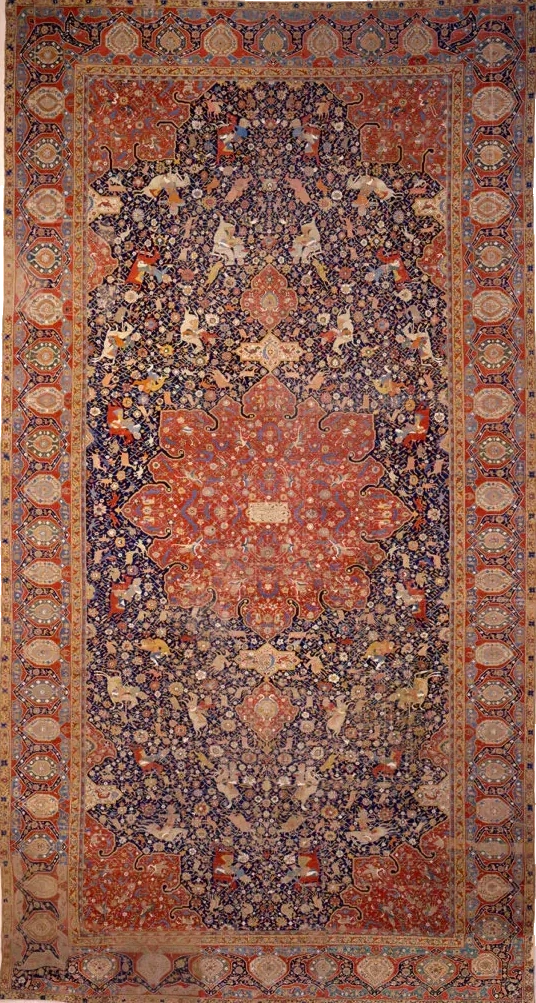
Another design legacy from the Safavid Dynasty is the central medallion, often containing animals, birds, or hunting figures ornamented with palm leaves and vines. Stylized human and angel figures and sometimes poems adorn the borders of some carpets.
The Vase design carpets, primarily made in southern Persia’s Kerman, significantly influenced rugs made during the Safavid Dynasty in the 16th and 17th centuries. These Persian carpets feature floral designs overflowing from vases, filling the rug’s field with flowers and leaves intertwined by branches.
Vase design rugs aim to emulate Persian court gardens. Over time, these designs permeated Persia and were adopted by other artists. These carpets continued to be produced throughout the 18th century, with evolving designs. In some instances, the vase is implied rather than explicitly depicted, while in others, it is extravagantly oversized.
Related reading: Kerman – A Persian Garden inside your home · Ardabil, the most famous carpet in the world · Are Heriz and Serapi identical rug types, or do they exhibit differences? · What distinguishes an artistic-level rug from a decorative one? · What is abrash? How to identify it?