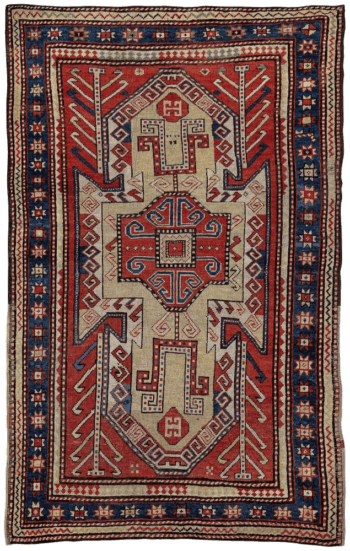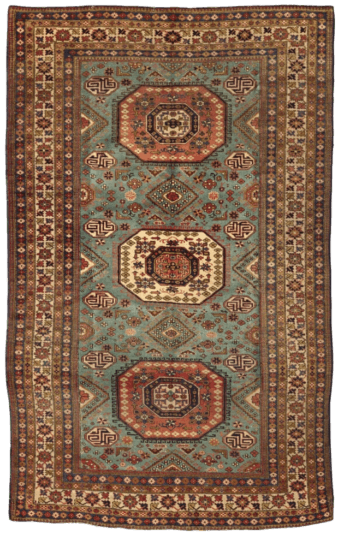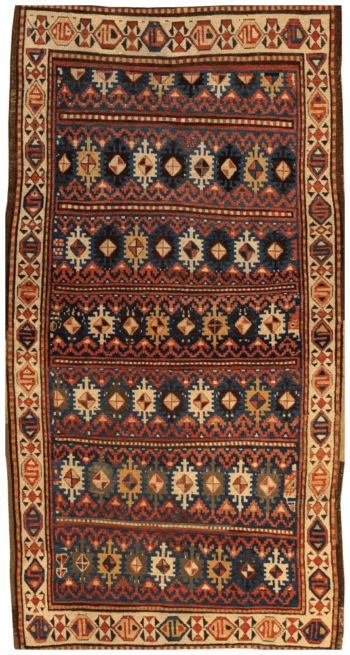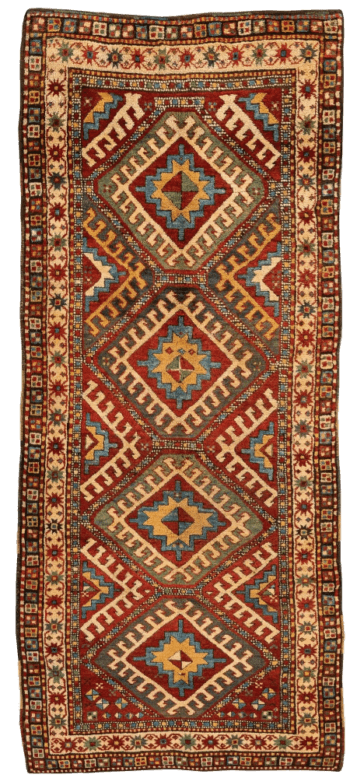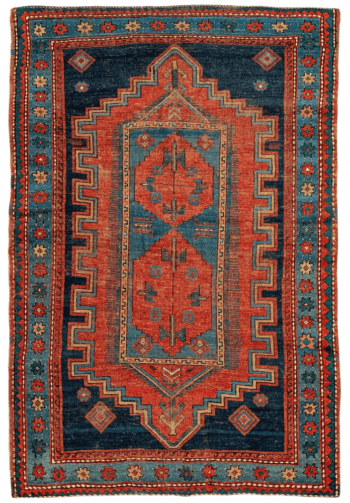
Among Caucasian weavings, the Kazak is the boldest and most instantly recognisable. Woven in the mountainous southwest of the Caucasus, these rugs trade fineness for force — large-scale geometry, saturated colour and a deep, glossy pile that has made them favourites of collectors for well over a century. Here is how to know one when you see it.
Where Kazak rugs come from
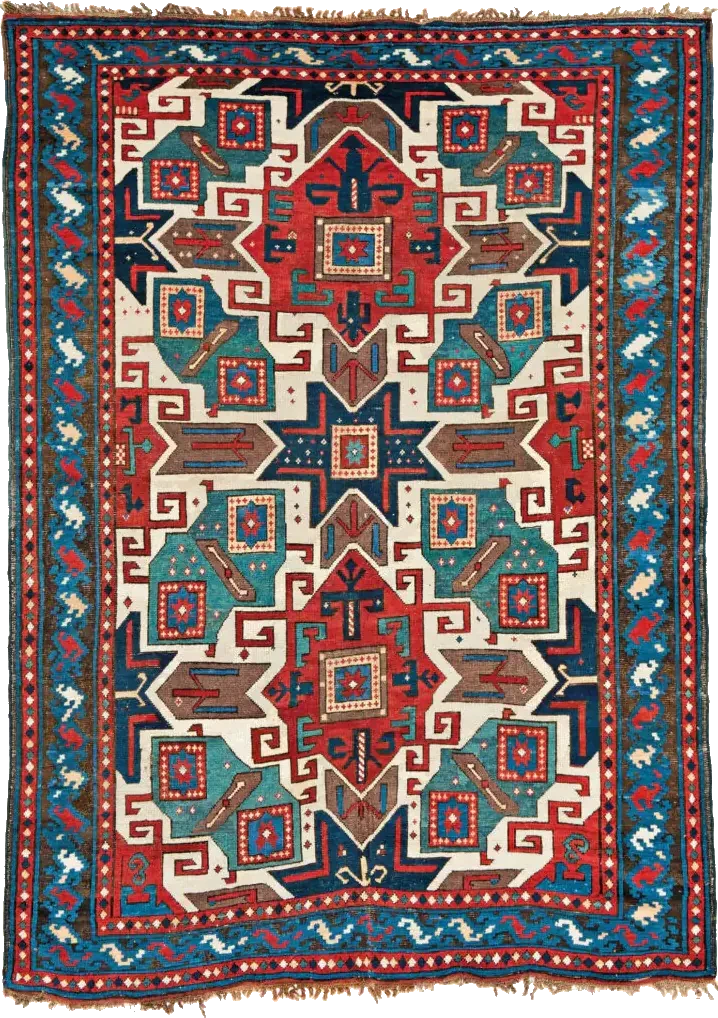
The name refers to a region, not a people: the Kazak district in the southwest Caucasus, spanning the highlands around present-day Armenia, Georgia and western Azerbaijan. Village and tribal weavers there worked wool of exceptional quality, drawing on a repertoire of bold, ancient motifs. Celebrated sub-groups — Lori-Pambak, Sevan, Karachov, Fachralo, Bordjalou and the sunburst “eagle” Kazaks — each have their own signatures, but all share the family’s unmistakable boldness.
How to recognise a Kazak
The format and handle
Kazaks are usually scatter to small-room size, often with a long, generous pile. Lift one and it feels substantial and meaty in the hand — heavier and thicker than the flat, fine weaves of the eastern Caucasus. The wool is long, lustrous and almost glossy, catching the light as you move.
The drawing and palette
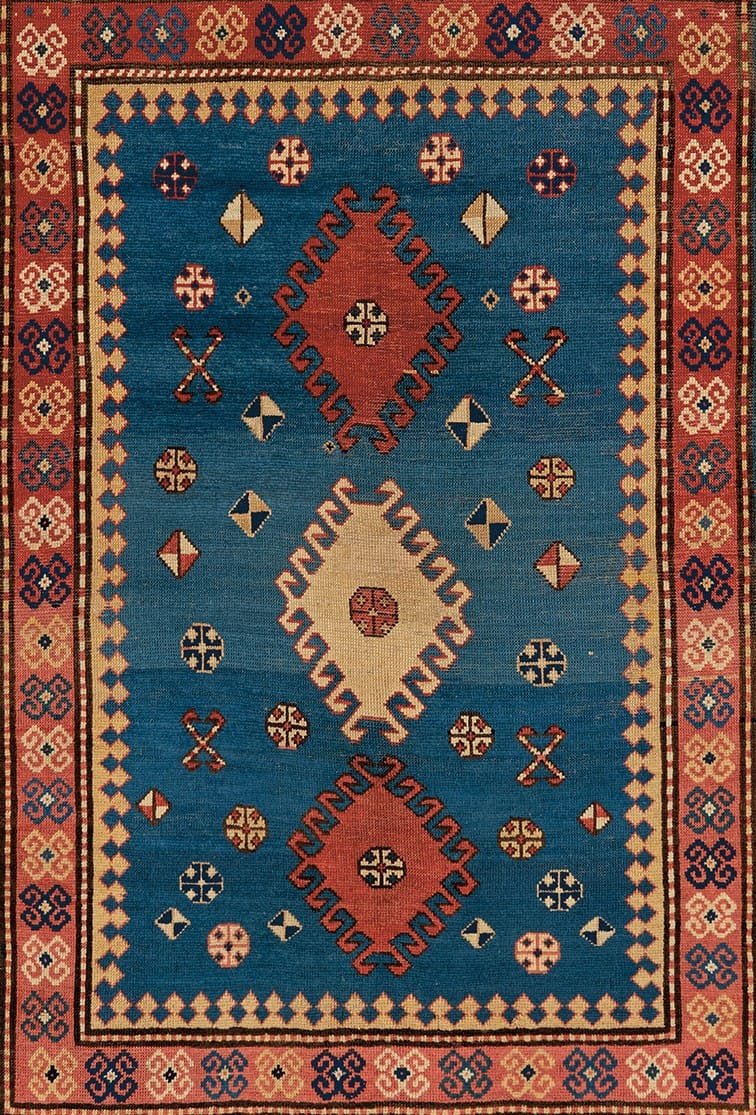
Think big and graphic. A Kazak typically carries one or two large medallions — shields, hooked diamonds, cruciform or sunburst forms — floating on an open field inside a strong, clearly drawn border. Motifs are few but commanding, with plenty of breathing space around them. The palette is deep and saturated: brick and madder reds, rich blues, ivory, and the greens and yellows that Caucasian dyers prized.
The wool and knot
Kazaks are tied with the symmetrical (Turkish) knot, and the knotting is deliberately coarser than in fine city or eastern-Caucasian rugs — you will see large, robust knots on the back and a lower knot count. That coarseness is not a flaw; it is what gives the Kazak its bold, architectural drawing and its legendary durability.
Kazak or Shirvan?
The two are often confused, but the tells are clear. A Shirvan, from the eastern Caucasus, is finer, flatter and shorter in pile, with small-scale, intricate patterns packed densely across the field. A Kazak is the opposite: longer pile, coarser knot, and a few large, bold motifs on an open ground. If the design is big, graphic and glowing with glossy wool, you are looking at a Kazak.
Caucasian rugs in the Figalli collection
Every Caucasian piece we offer is chosen for authenticity, age and character. Message us on WhatsApp and our team will gladly help you understand a specific rug.