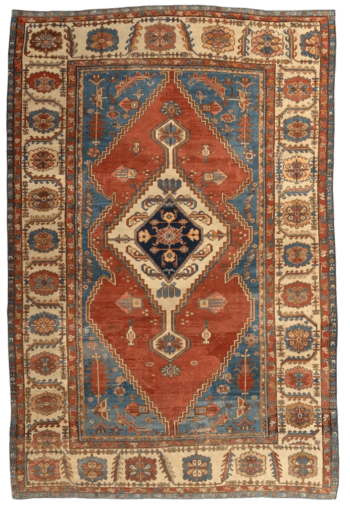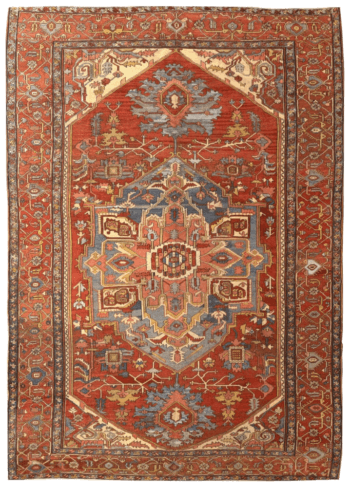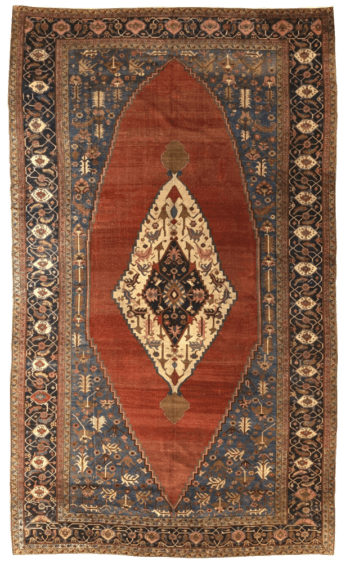
What is the difference between a Heriz and a Serapi? First, it is a valid question because there is no place called Serapi, although there are villages in the Heriz region. Second, antique Serapi and Heriz rugs were produced in the same area. However, antique Serapi are most valued today.
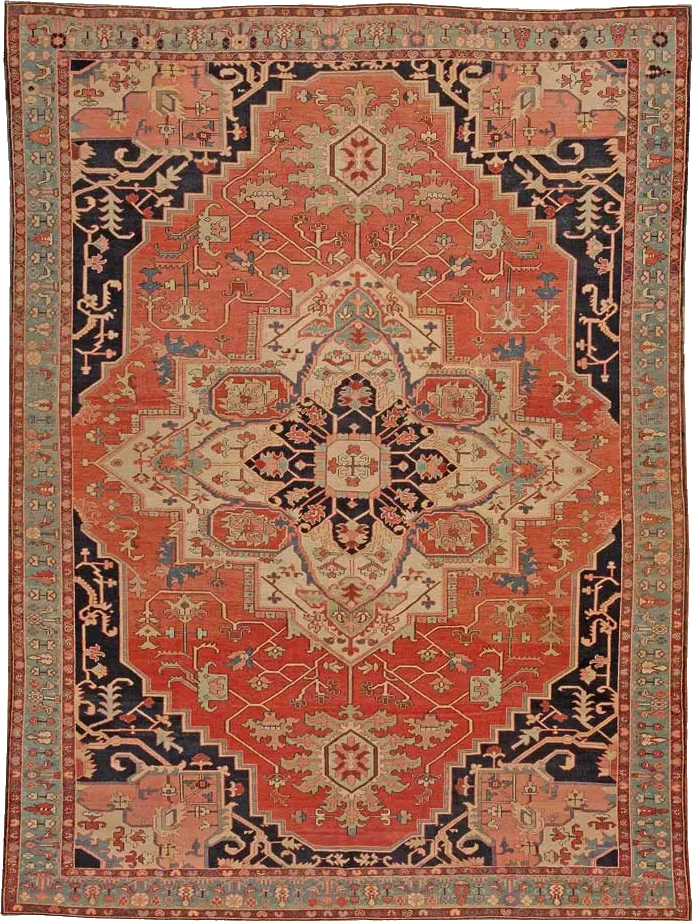
Classic Heriz rugs are known for their robust central medallion, complemented by four corner panels. These rugs feature vibrant, crisp colors derived from vegetable dyes, woven into large geometric floral designs. The wool is dyed in shades of red and pink from madder root, and blues from indigo, forming rectilinear designs, a departure from the curvilinear patterns seen in more formal Persian rugs.Antique Heriz rugs, influenced by the 16th and 17th-century Safavid dynasty, offer a more rustic interpretation, resulting in a relaxed and cozy style. These rugs were handcrafted by 19th-century artisans who didn’t adhere to a strict design model. The designs were learned by women growing up in homes where rug weaving was prevalent, each adding their unique interpretations to the art. As a result, while you may find antique Heriz rugs with similar patterns, no two are identical.
Among rug traders, Heriz became the widely accepted term for all the dozens of villages that wove rugs in this style. Ahar, Mehrivan, Gorevan, and others are applied to Heriz rugs. All are names of neighbouring towns, and each carpet is made with unique characteristics linked to these locations. For example, a Gorevan is made in the Gorevan village and is generally a larger rug, and its knots are the thickest of the Heriz family rugs. Karadja is produced in the town of the same name and is a Heriz with a distinct geometric pattern, formed by a hook-shaped diamond flanked by two medallions arranged along a vertical axis in the centre. Serapi was the name used for the oldest and most refined of these rugs. At the end of the 19th century, dealers, traders, and importers classified and mentioned the names of these villages on their invoices and shipping statements about the quality and value of the pieces, asking for a higher price for the most exquisite pieces.
The term “Serapi” is often misunderstood to refer to a separate village, akin to the naming convention of other rugs. However, it’s a misinterpretation of the village name “Serab”. Some suggest that “Serapi” signifies origin from Serab. However, essentially, a Serapi rug is an antique Heriz rug, woven before 1910. The term “Serapi” was coined to denote these older, higher quality Heriz rugs.
Serapi rugs are distinguished by superior wool quality, a more basic design, and a limited color palette. They differ from Heriz rugs in weave and design specifics. Heriz rugs typically feature darker, vibrant colors and intricate details. In contrast, Serapi rugs have a more open design with fewer geometric figures and softer tones. Serapi rugs are always antiques, while Heriz rugs are still produced today. The appeal of Serapi rugs lies in their finer, superior quality weave.
As a result, due to their rarity, Serapi are generally pricier than Heriz rugs. Modern reproductions attempt to mimic the terracotta colors and rounded designs characteristic of Serapi rugs, but at a lower cost.
Heriz or Serapi? How to tell the two apart
Heriz and Serapi rugs come from exactly the same place — the Heriz district in the mountains of north-west Persia, east of Tabriz — so the two names do not mark two origins. What they mark is grade and age within one weaving tradition, and knowing the difference tells you a great deal about a rug.
Heriz: the bold, sturdy medallion carpet
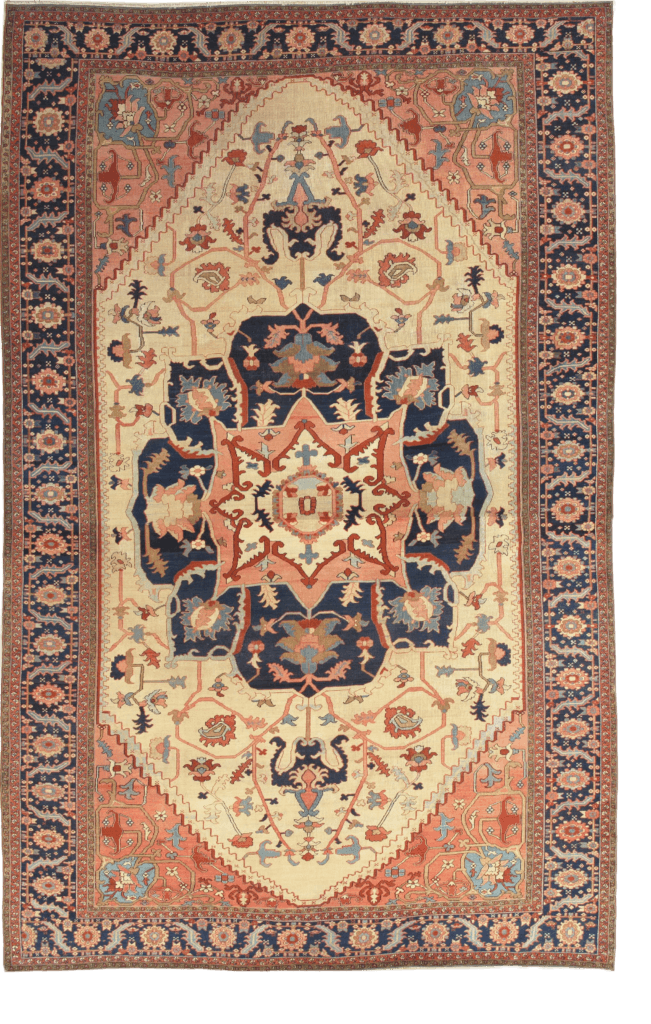
“Heriz” is the general name. A classic Heriz is a robust, room-size carpet with a large, angular geometric medallion, a brick-red field, ivory corners and navy accents, and thick wool pile on a cotton foundation. These are the durable, handsome workhorses that furnished European and American drawing rooms for a century — you can place one by its drawing, as our guide to reading a rug’s origin from its pattern explains.
Serapi: the finest, older Heriz
“Serapi” is not a different village but a trade grade — traditionally the finest and usually the oldest Heriz rugs, roughly late-nineteenth-century and before. A Serapi is more finely knotted, its drawing more spacious and elegant, and its palette softer and more varied, often with the gentle colour shifts of natural dyes. Where a Heriz is bold and saturated, a Serapi is airy and refined.
So which is which?
Every Serapi is a Heriz, but only the finest antique Heriz earn the name Serapi. The distinction is one of quality and age inside a single weaving area, not of geography — which is exactly why a fine Serapi commands a premium over a standard Heriz of the same size (see our guide on how rug values are determined).
Quick answers
Is a Serapi the same as a Heriz? They come from the same district, so in origin, yes. “Serapi” is the name given to the finest, usually older Heriz rugs — so every Serapi is a Heriz, but not every Heriz is a Serapi.
What makes a rug a Serapi? A finer weave, a more open and elegant drawing, a softer and more varied palette, and usually greater age — late-nineteenth-century or earlier. It is a mark of quality within the Heriz family.
Which is more valuable, Heriz or Serapi? At the same size and condition a genuine antique Serapi generally out-values a standard Heriz, because it is finer and rarer — but condition, colour and drawing decide each individual case.
Antique rugs in the Figalli collection
Explore the hand-knotted antique pieces in the Figalli catalogue — each chosen for its artistry, its natural dyes and its state of preservation.
Related reading: Creating vibrant interiors: transform your space with the charm of ancient Tabriz rugs · How was the salmon-pink colour of the ancient Sarouk rugs made? · How to style your home with antique Heriz rugs · Would You Pay £5,442,000 for a Rug? Yes! · Why Antique Rugs Stand Out