
The Gendje rug is one of the great village weavings of the Caucasus — a close cousin of the Kazak, but with a character all its own. Named after the town of Gendje (Ganja) in western Azerbaijan, it is bold and tribal like its neighbours, yet it tends to speak in smaller, busier, more repetitive patterns, often on a long, narrow format. Once you know the signs, a Gendje is easy to place.
Where Gendje rugs come from
Gendje (also spelled Ganja, and known in the nineteenth century as Elizavetpol) is a town and weaving district in the western Caucasus, in present-day Azerbaijan, close to the Armenian highlands where the Kazak rugs are made. Gendje and Kazak share a world — the same mountain wool, the same symmetric knot, the same love of bold geometry — which is exactly why the two are so often confused.
How to recognise a Gendje
The format
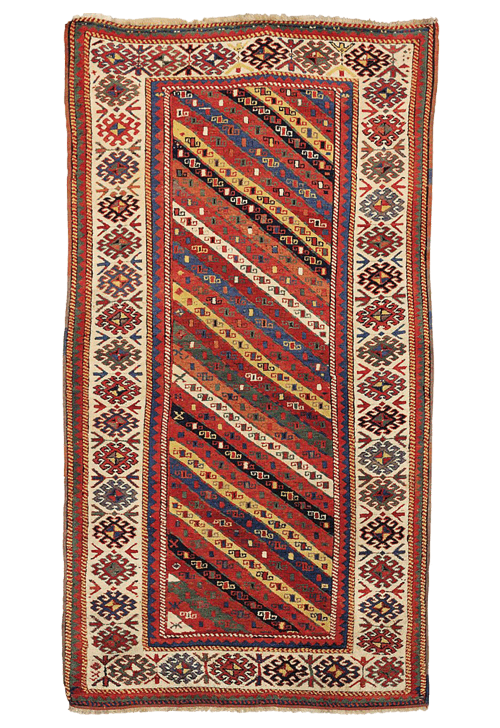
Gendje rugs are frequently long and relatively narrow — runners and elongated “kelleh” proportions are common — where a Kazak is more often a squarer scatter size. A long Caucasian rug with a busy, repeating field is a strong first clue that you are looking at a Gendje.
Where a Kazak fills the field with one or two large medallions, a Gendje tends to cover it with many small, repeating elements: diagonal stripes of little motifs (the classic “Gendje stripe”), all-over lattices, rows of small hooked medallions or eight-pointed stars. The palette is the bold Caucasian one — madder red, indigo blue, ivory, with yellows and greens — read our guide to the meaning of Caucasian rug symbols to decode the little forms.
The wool and weave
Like its neighbours, a Gendje has a lustrous wool pile on a wool foundation, tied with the symmetric (Turkish) knot, and a substantial handle. The weave is generally coarse to medium — this is village weaving, prized for colour and character rather than for fineness.
Gendje or Kazak?
They are cousins from the same corner of the Caucasus, so some overlap is natural. The rule of thumb: a Kazak is bolder and more open, built around a few big forms; a Gendje is busier and more repetitive, often longer, built from many small ones. For the full Kazak picture see how to recognise a Kazak rug, and for the wider family, the charm of antique Caucasian rugs.
Quick answers
Where do Gendje rugs come from? From the town and district of Gendje (Ganja) in the western Caucasus, in present-day Azerbaijan — the same region that produces the Kazak rugs.
How do you recognise a Gendje? Look for a long, narrow format; a busy field of small, repeating motifs such as diagonal stripes, lattices or rows of little medallions; the bold Caucasian palette; and a lustrous wool pile on a wool foundation with a symmetric knot.
Are Gendje and Kazak the same? No, but they are close cousins from the same area. A Kazak is bolder and more open with a few large forms; a Gendje is busier, more repetitive and often longer.
Caucasian rugs in the Figalli collection
The collection features several antique Caucasian weavings from the same world as the Gendje — among them Kazaks and Shirvans. Browse them all in the Figalli catalogue, or see the short Gendje entry in our rug guide.
Related reading: Interpretations of Caucasian rug patterns · Discover the cultural and artistic values of the Caucasian Kazak rugs · The irresistible charm of ancient Caucasian rugs · The Art of Hanging Antique Rugs on Walls · Rugs with solid and vibrant colours remain attractive works of art