
In the world of rugs, the term “antique” implies more than just a measure of time. It encompasses a range of desirable characteristics related to design quality, weaving technique, and materials used. In monetary terms, “antiquity” equates to a higher cost because antique rugs, i.e., those made before 1920, are a finite commodity whose number can only decrease, never increase.
Indeed, the years around 1920 marked a turning point in rug production. From this time, natural vegetable dyes were widely replaced by synthetic dyes that lacked the depth, intensity, and subtlety of the previously used natural dyes. It was also a time when machine-spun yarns replaced hand-spun wool.
These changes had a significant impact on the appearance of rugs. Natural vegetable dyes produced more vibrant colours and varied in their hue, providing a depth effect on the rug’s surface. Similarly, the irregular texture of hand-spun wool was more varied in its properties than machine-spun yarns.
Therefore, antique rugs with hand-spun wool and natural dyes have a more luminous and vibrant surface, producing a visual depth effect, while rugs made in the period approaching 1950 have, by comparison, a more opaque, flat, and monotonous surface.
Furthermore, the design of 20th-century rugs began to change. As the international market opened up, weavers began to focus on the quantity of rug production. Not only did the quality of the materials suffer, but the rug designs were simplified to the extreme so that more rugs could be made more quickly.
Ultimately, the distinction between antique rugs and pieces from the period close to the 1920s goes far beyond calculating a rug’s age. It is, in fact, a distinction of quality at all levels.
Antique, vintage or new rug? What “antique” really means
“Antique”, “vintage” and “new” are not just labels on a price tag — they place a rug in time, and time is one of the things a collector is really buying. The boundaries are trade conventions rather than exact laws, and they vary a little from dealer to dealer, but the four bands below are the ones almost everyone uses.
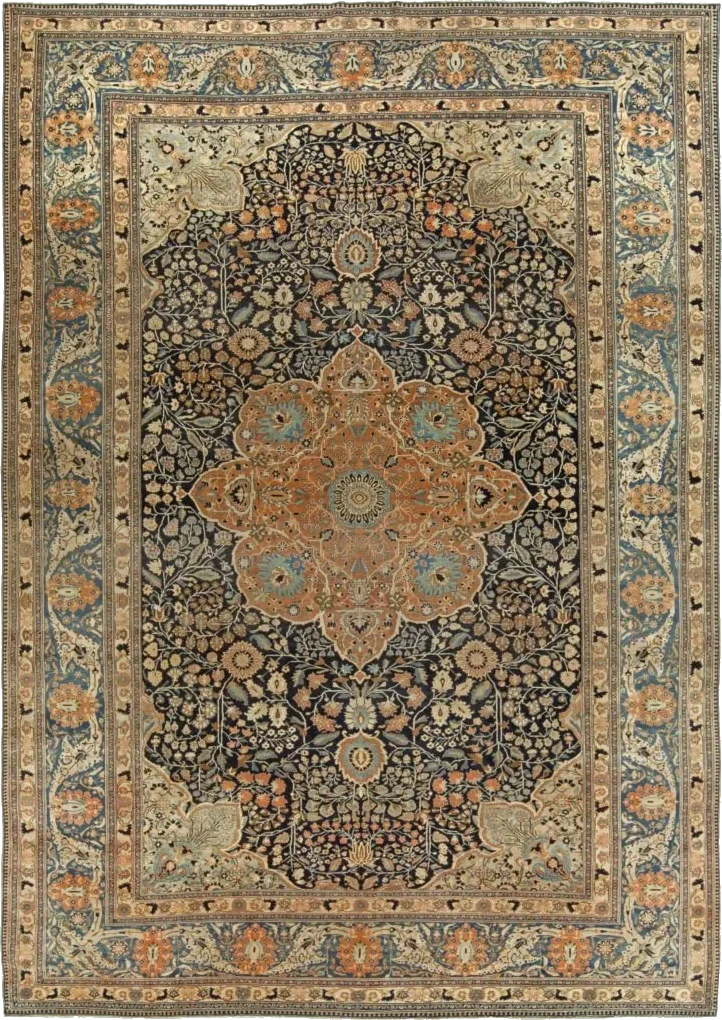
Antique rug types: the four age bands
Antique — roughly a century old or more. In practice the trade treats about 80 years as the threshold, while some authorities (and US customs) draw the line at a full 100 years. These are the rugs woven before synthetic dyes and machine-spun wool became the norm.
Semi-antique — roughly 50 to 100 years old: pieces from the earlier twentieth century that are ageing into the antique category but are not quite there yet.
Vintage — roughly 20 to 50 years old, typically mid- to late-twentieth century. Old enough to have character and a little patina, but not yet historical.
New or contemporary — under about 20 years old, woven in the modern market.
Why the age band matters
The date decides the materials. A genuinely antique rug was made before aniline and chrome dyes and before machine-spun yarn, so it carries hand-spun, lanolin-rich wool and natural dyes — madder red, indigo blue — which age into the soft glow and the gentle colour variation of naturally dyed wool that a new rug cannot fake. It also decides the intent: antique village and tribal rugs were made for use, dowry and prayer rather than for export, and that is felt in the drawing. And it decides the value — antique pieces are a finite, non-renewable supply, so at comparable quality an antique will out-value a modern rug of the same design (how value is built is set out in our guide on how rug values are determined).
How to place a rug in its band
You rarely get a birth certificate, so you read the rug: the abrash and depth of natural dyes, the slight irregularity of hand-spun wool, honest wear and patina on the pile, and the look of the back. Our guide on estimating a rug’s age from its features walks through exactly what to check.
Quick answers
How old does a rug have to be to be “antique”? By common trade usage, about 80 years or more; by the stricter definition used in customs and some scholarship, a full 100 years. Below that a rug is usually called semi-antique, vintage or new.
What is the difference between antique, vintage and new? Age, and what age brings. Antique (roughly 100+ years) means natural dyes, hand-spun wool and pre-industrial artistry; vintage (roughly 20–50 years) means some character but modern materials; new means recently woven. Semi-antique sits between antique and vintage.
Does age make a rug more valuable? Age helps, but only together with quality. A masterly antique will out-value a mediocre new rug — but a worn, coarse antique is worth less than a fine newer piece. Origin, dyes, condition and artistry decide the rest.
Antique rugs in the Figalli collection
Figalli deals in genuinely antique oriental rugs — pieces chosen for their natural dyes, their artistry and their state of preservation. Browse the whole collection in the Figalli catalogue.
Related reading: How to protect your antique oriental rugs from your pet · Revitalizing Your Space with Antique Rugs · Would You Pay £5,442,000 for a Rug? Yes! · A Guide to Valuing the Artistry of Durable Ancient Heriz Rugs · How to Recognise a Lesghi Rug