
Only experience, gained over the years, allows someone to confidently determine the approximate time in which a rug was made. Over time, the understandable initial confusion about quality, the different styles and periods in which a rug was made disappears. Love for the subject plays a considerable role here. As in other fields, the specialist’s knowledge is based on his vision and comparison.
In contrast to other works of art, however, the carpet reveals more criteria on which one can base one’s judgment, for in no other object of artistic creation do touch, handling and sensation play such an important role in evaluating its quality. age.
First of all, the general impression you have of a rug is essential to find clues about its age. In Caucasian and Turkmen rugs, where geometric and abstract designs have been widely used over the centuries, the antique rug is one in which the design is presented in the most realistic way. The truth is that stylistic purity, careful execution and the relationship between the edge and the central field are important elements when evaluating any rug. It should be noted, however, that older rugs have a narrower border than later examples.
In addition to aesthetics, colors can also betray the judgment one makes about the age of a rug. The intense clarity of an antique rug, regardless of the region in which it was woven, is a compelling guide. Even the seemingly monotonous Turkmen carpets are a good example of this. The older the rug, the more its colors stand out. Yomud and Tekke carpets, for example, can achieve a range and intensity of colors that would not be imagined possible, given the limited choice of colors used in carpets made later in this region.
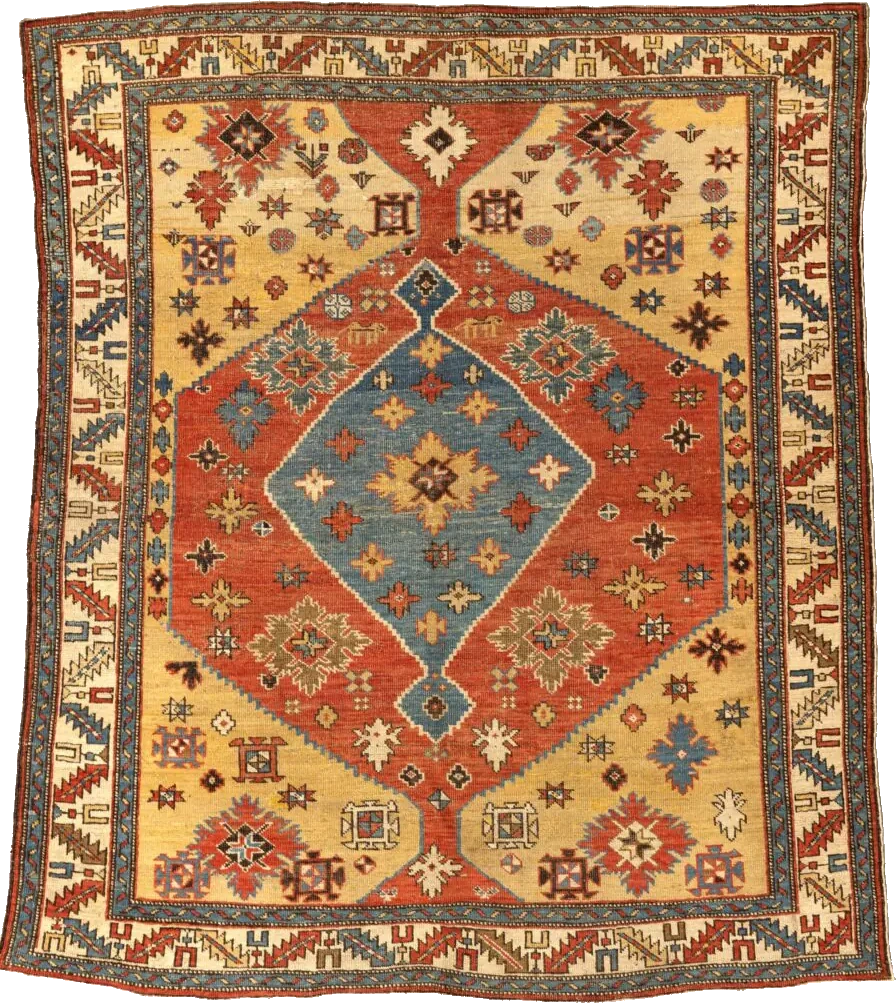
An infallible characteristic in determining the age of a rug is the color yellow. The older the carpet, the lighter and purer its yellow color. In carpets that are not so old, yellow tends to have more orange or brown tones. The other colors should also stand out clearly and brightly if the rug is antique. Conversely, the blurrier the overall image of the rug, the more the colors appear to blend together and therefore the newer the rug. The basic condition for the intensity and clarity of colors is the quality of the wool used. The velvety, natural shine of antique rugs survives for centuries and remains unmistakably preserved even in the knots of well-worn pieces. This shine therefore represents one of the most important indications for determining your age.
Other information that helps identify the lifespan of a carpet can be found in its structure. The older the carpet, the longer it has faced climate influences. Thus, the structure of old carpets becomes brittle or at least partially damaged. Sometimes it is the warp, sometimes the weft, depending on the susceptibility of the material. Of course, it is more desirable to own an antique rug that is completely preserved. However, slight weakness in the rug does not necessarily mean a loss in its value. Naturally, rugs that have a more rigid structure or are made with a very narrow weave tend to be more fragile, as when folded there is greater pressure on them than in rugs made with looser knots and a soft texture. One often sees the bad habit that some dealers and collectors have when subjecting an antique rug to a test, folding the back with their hands. The damage is irreparable and this test often does not produce the answer sought. If the back of a century-old rug is in perfect condition, it should remain in this condition. If basic care is taken, it will last a hundred years longer. But if enough force is applied to break it to test its age, any carpet can be damaged.
The dye test: a calendar woven into the rug
If colours give the first clues, chemistry gives the dates. Until the middle of the 19th century, every rug in the world was coloured with natural dyes – madder for reds, indigo for blues, weld for yellows, walnut husks and oak galls for browns. In 1856 the first synthetic dye was invented, and from the 1860s-70s onward the new aniline colours began reaching Persian and Anatolian looms. They were cheap and vivid, but many faded badly or shifted tone – early synthetic reds, for instance, tended to turn brownish or bleed into neighbouring areas.
This is why dyes work like a calendar. A rug whose colours are all natural was almost certainly woven before the 1870s-80s, or by weavers who deliberately kept the old recipes; the presence of certain early synthetic colours places a piece after that turning point; and the flat, perfectly even palette of chrome dyes points to the 1920s or later. The soft horizontal colour shifts known as abrash – the subject of the article linked below – are themselves a signature of natural dyeing in small batches, and their complete absence in a supposedly old rug is a warning sign.
A collector’s quick checklist
Experts rarely rely on a single clue; they add small verdicts together. Before judging a rug’s age, look at: the clarity and translucence of the colours; the light, pure tone of the yellows; the natural sheen and softness of the wool; the presence and behaviour of abrash; the definition of the knots on the back and the polish that use has given it; the corrosion of dark browns and blacks; and the coherence between design, border and weave of the region it claims to come from. When all of these point in the same direction, the rug speaks for itself – exactly as the genuine piece described above leaves no doubt at first sight.
Read also: What is abrash? How to identify it?
An easier indication of age is provided by the composition of the rug’s backing. The back of a new rug has each knot well defined. The nodes are intact, and you can clearly see where one node ends and the next begins. Plus, the back is plush. Due to the constant wear and friction caused by the simple fact that the carpet is on the floor, the knots are no longer well defined, they become more uniform and decrease in size. The fuzzy layer is lost and the back becomes smooth and shiny. When the carpet reaches this state it can be determined that it has reached a considerable age.
There are certain natural dyes that, due to their chemical composition, end up corroding the wool of old carpets over time. This occurs mainly with dark colors such as brown and dark green. The stronger the corrosive material (iron or copper oxide) contained in the color, the faster the wool clumps will disappear from the surface of the carpet.
On average, after 60 or 80 years, a carpet may begin to show signs of mold, but there are those that take a hundred years or more before this process becomes evident. As there are also natural colored black and brown wools – undyed wool from sheep, goats or camels in black and brown – it is not difficult to find antique rugs that have these well-preserved colors.
Manufacturers of counterfeit antique carpets obviously know all these processes. In addition to scraping off the brown and black parts of the carpet that they are faking to give the appearance of etching these colors, they abrade the backing of the carpets so that they appear smooth and without fluff. However, a trained eye can spot a fake rug even if it has been faithfully copied.

It is the colors that reveal counterfeiting. A counterfeit rug does not have translucent colors nor does its wool have a natural shine. The backing is often very stiff and signs of wear purposely made in irregular places turn out to actually be hairs that have been cut short that lie evenly over the surface of the rug. The experienced collector relies on the principle that if he has to analyze at length whether a rug is genuine or not, he will consider it a forgery. The first look at the rug that is genuine leaves no doubt in your mind.
Related reading: Revitalizing Your Space with Antique Rugs · Would You Pay £5,442,000 for a Rug? Yes! · Why Antique Rugs Stand Out · Are Heriz and Serapi identical rug types, or do they exhibit differences? · The irresistible charm of ancient Caucasian rugs