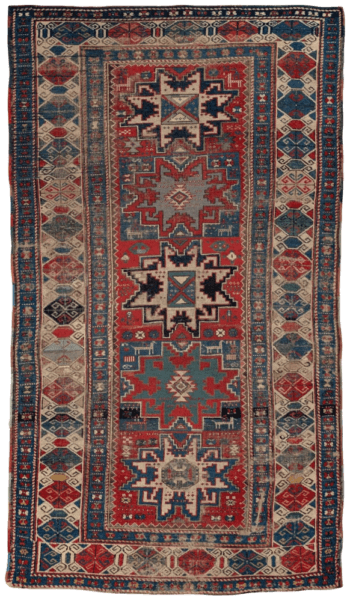
The Lesghi rug is the easiest Caucasian weaving to name, because it wears its signature on its sleeve: a bold, eight-pointed “Lesghi star” repeated in a column down the field. Woven by the Lezgin people of the north-eastern Caucasus, it belongs to the same East Caucasian world as the Shirvan and Kuba, but that unmistakable star sets it apart at a glance.
Where Lesghi rugs come from
Lesghi (or Lezgi) rugs are named after the Lezgin people of the north-eastern Caucasus, in Dagestan and the neighbouring border of northern Azerbaijan. This is East Caucasian country — the same broad family as the Shirvan and Kuba weaves — and a Lesghi shares their symmetric knot, their wool foundation and their love of clear, saturated colour. What makes it its own type is not where it was made but the motif it is built around.
How to recognise a Lesghi
The Lesghi star
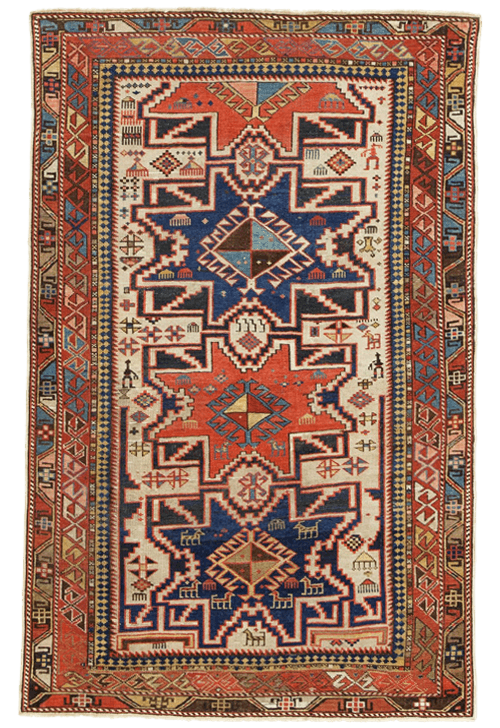
This is the whole game. The Lesghi star is a large eight-pointed star with stepped, hooked rays, usually stacked in a vertical row of two, three or four down the centre of the field, each star in a different colour — indigo, madder, ivory, gold. If a Caucasian rug is organised around a column of big hooked eight-pointed stars, you are almost certainly looking at a Lesghi.
The drawing and palette
Around the stars, the field is filled with small scattered motifs — little animals, combs, rosettes and “S” forms — on a dark blue or ivory ground, and framed by crisp geometric borders. The palette is the bold Caucasian one: deep indigo, madder red, ivory and yellow. Read our guide to the meaning of Caucasian rug symbols to decode the smaller shapes around the stars.
The wool and weave
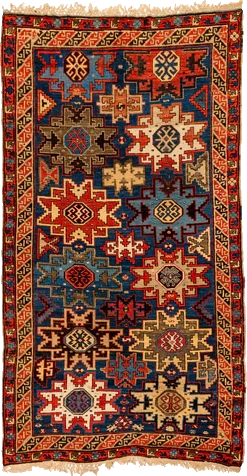
A Lesghi is tied with the symmetric (Turkish) knot on a wool foundation, in a medium weave — finer and flatter than a shaggy Kazak, but usually bolder and less minute than a fine Shirvan. The wool is lustrous and the colours clear.
Lesghi, Shirvan or Kazak?
Because the Lesghi lives in the East Caucasian family, it is closest to the Shirvan — but where a Shirvan spreads many tiny motifs evenly across the field, a Lesghi organises everything around its column of big stars. It is quite unlike the thick, open highland Kazak and Gendje, which build from one or two large medallions. In short: a column of hooked stars, think Lesghi; an even all-over pattern, think Shirvan; big bold medallions in a shaggy weave, think Kazak. For the whole family, see the charm of antique Caucasian rugs.
Quick answers
Where do Lesghi rugs come from? From the Lezgin people of the north-eastern Caucasus — Dagestan and the northern Azerbaijan border — part of the wider East Caucasian family alongside Shirvan and Kuba.
How do you recognise a Lesghi? Look for the “Lesghi star”: a column of large, eight-pointed, hooked stars in alternating colours down the field, surrounded by small scattered motifs, in a bold indigo-and-madder palette on a medium wool weave.
Is the Lesghi star only found on Lesghi rugs? The star appears as a motif on other Caucasian rugs too, but when a rug is built around a whole column of them, it is called a Lesghi.
Caucasian rugs in the Figalli collection
The collection includes an antique Lesghi from Dagestan. Browse the full range in the Figalli catalogue, or see the short Lesghi entry in our rug guide.
Related reading: How to Recognise a Shirvan Rug · How to Recognise a Gendje Rug · Concise History of Armenian Rug Production · How to find out the origin of an antique rug by its pattern · Tips for Positioning and Choosing the Right Rug Size for Each Room in Your Home