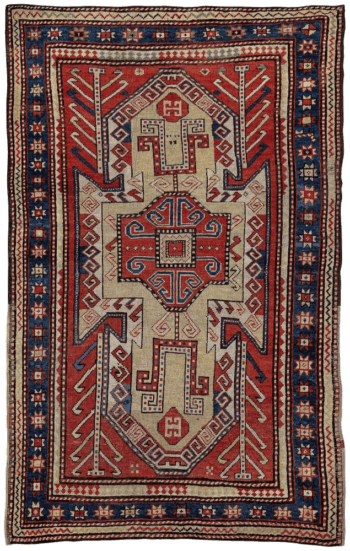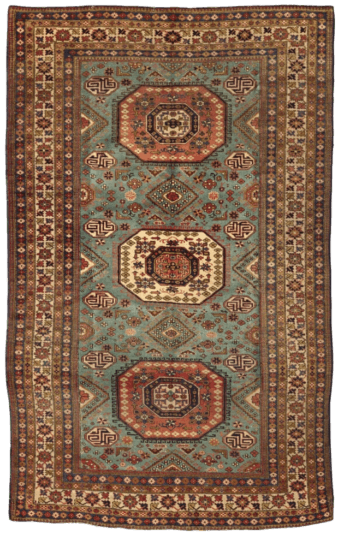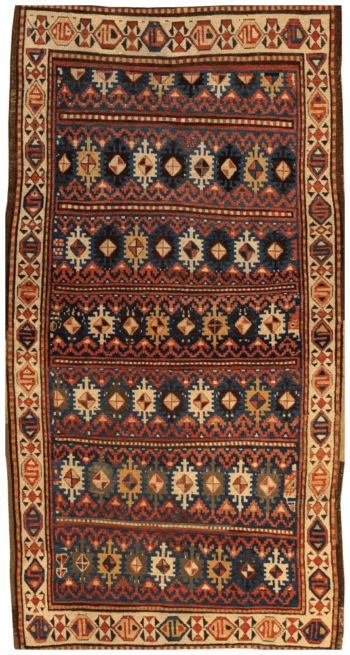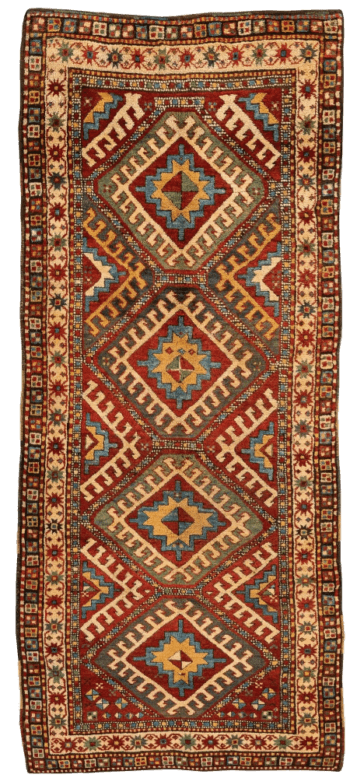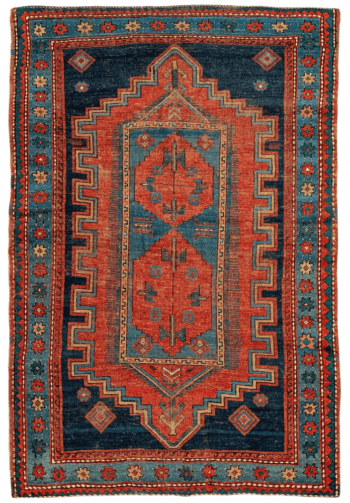
Artists who lived in small villages that inhabited the majestic mountains of central Caucasus for centuries created a robust rug style known as Kazak. As trade routes expanded and became more populated, pieces of Kazak rugs reached Europe, Asia, and the Americas. By the 18th and 19th centuries, these rugs won the admiration of collectors and museums internationally.
The region of Kazak is located in the Republic of Armenia, northwest of Lake Sewan (it does not refer to Kazakhstan, a country situated on the opposite side of the Caspian Sea). Regarding rug production, Kazak is the most famous area of the Caucasus, as the best rugs produced there in the past combine impressive geometric designs with incredible colours made with high-quality natural dyes. It is possible to attribute some rugs from this area to specific villages, such as Lambalo, Borjalou, Fachralo, Lori Pamback, Karachov, Sewan, and Shulaver. But when a piece cannot be accurately identified, it is called Kazak or by reference to the design it presents. It is the case with rugs known as “Star Kazak”, “Wheel Kazak”, “Tree Kazak”, “Dragon Kazak”, and “Shield Kazak”.
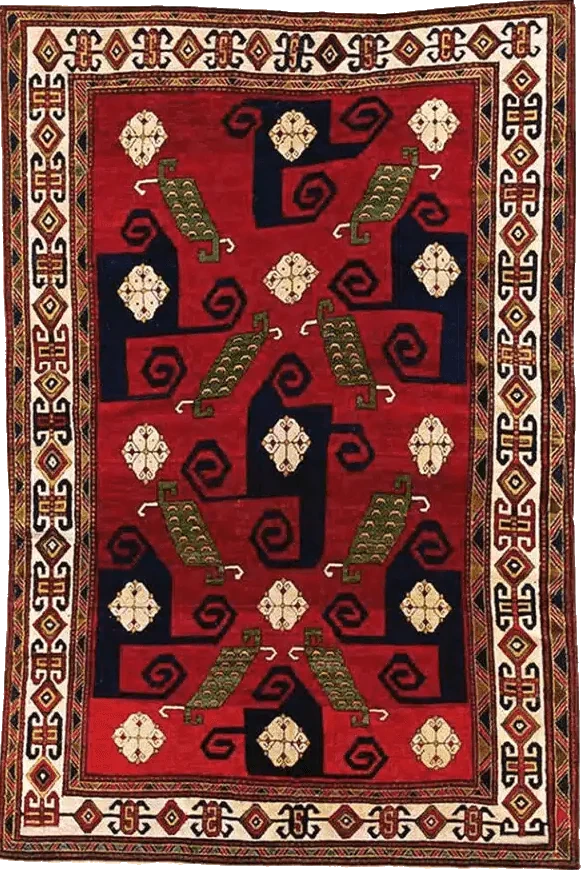
The design of Kazak rugs is usually simple and geometric. Warmer colours are preferred, and the wool is thick and of excellent quality, often lustrous. Unlike other styles of antique rugs, in many 19th-century Kazak rugs, large archetypal designs dominate the rug field with majestic proportions that amplify the powerful effect of their iconography. These designs express a mainly mythological character, exploring the intimate interaction between heaven and earth. Some of their geometric designs were found in metal works made in the Paleolithic period, which produced profound effects on their observers in numerous ways. Designs known as “wisdom stars”, “life wheels”, “ram’s horn”, and “safety fence”, among many others, populate these rugs. Woven with naturally lustrous, long-haired wool from the sheep raised by the artists themselves, who made them and dyed them under a slow process to obtain saturation, the best Kazak rugs display spectacular colours, from scarlet to lapis lazuli, from fern green to gold.
How to recognise a Kazak rug
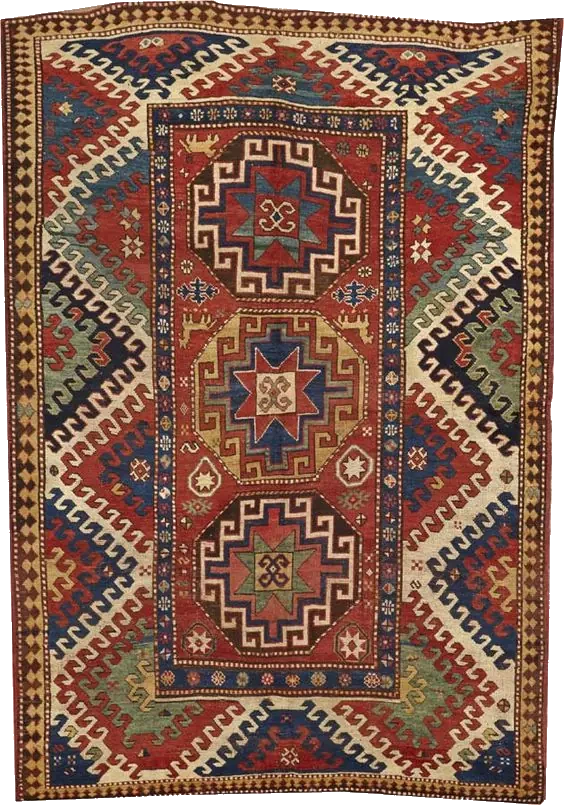
Kazak rugs are among the most recognisable of all oriental weavings — bold, geometric and unmistakably tribal. They were woven in the south-western Caucasus, in the Armenian and Azerbaijani highlands between the Black and Caspian Seas, and everything about them favours boldness over refinement. Once you know what to look for, a Kazak is hard to mistake for anything else.
1. A small palette used at full strength
A Kazak speaks in a few loud colours rather than many soft ones: a deep madder red, ivory or cream, and a strong blue, with occasional accents of green, gold and brown. The colours sit in large, flat fields with sharp borders between them — no gentle shading, no dozens of tones. That high-contrast, almost poster-like clarity is the first thing that says “Kazak”.
2. Large-scale, angular geometry
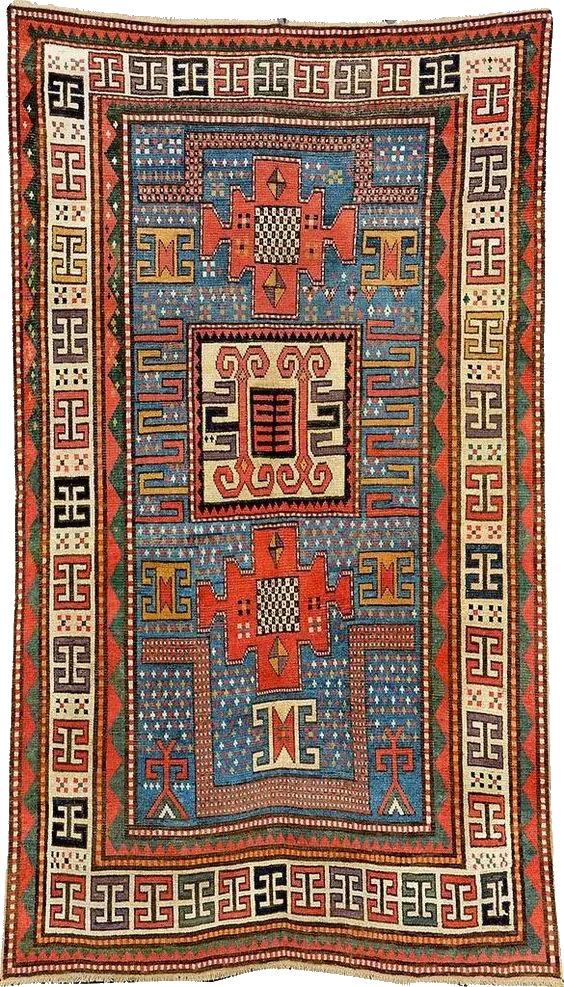
Where a Persian city rug curves and flowers, a Kazak is drawn with a ruler and a bold hand: big medallions, hooked diamonds, eight-pointed stars, latch-hooks and stepped outlines, often just one or two dominant forms filling the whole field. Everything is angular, because everything is counted knot by knot from memory rather than from a painted cartoon.
3. The wool and the handle
Pick a Kazak up and it feels substantial. The pile is long, lustrous and almost shaggy — higher than most other Caucasian rugs — and both the warp and the weft are usually wool, not cotton. The knotting is relatively coarse: a Kazak is not about high knot counts but about strong wool, glowing colour and confident drawing. The symmetric (Turkish) knot is used throughout.
4. Reading the “sub-types” by their drawing
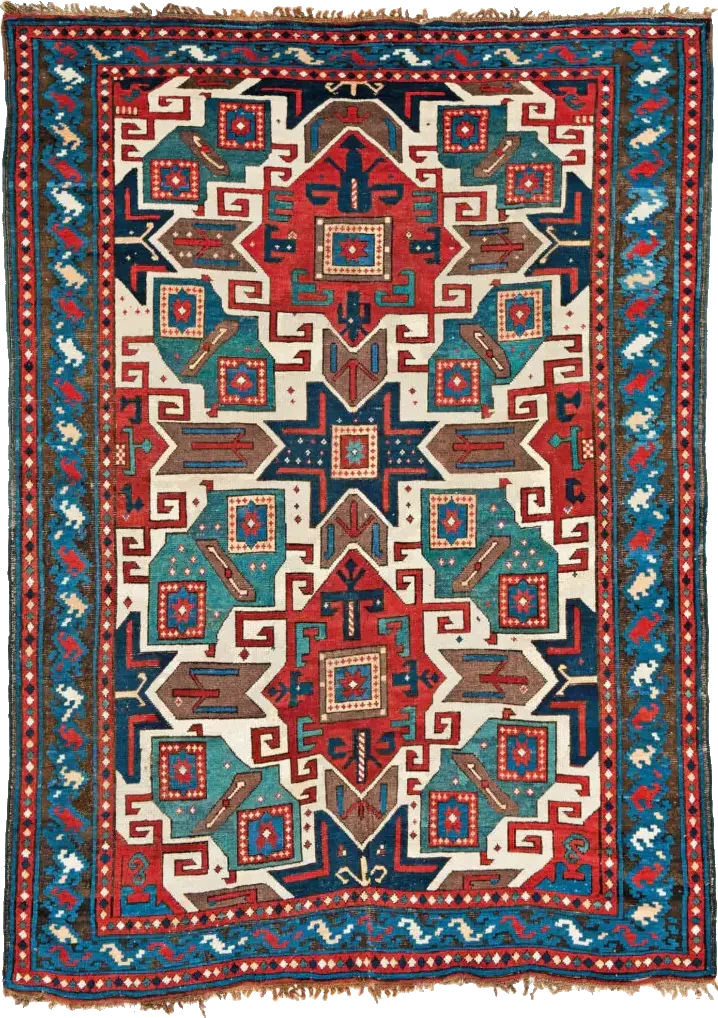
Collectors name Kazaks by district and pattern: the Sevan Kazak with its great cruciform shield medallion; the Chelaberd or “Eagle Kazak” with its radiating sunburst; the Karachov (Karachopf) with a large central square framed by white-ground octagons; plus Lori-Pambak, Fachralo prayer rugs and Bordjalou. This vocabulary is shared with the wider Caucasus — see our guides to the meaning of Caucasian rug patterns and the charm of antique Caucasian rugs.
Quick answers
How can you tell a rug is a Kazak? Look for four things together: a small, high-contrast palette (madder red, ivory, blue); large, angular geometric forms rather than curved flowers; a long, lustrous wool pile on a wool foundation with a heavy handle; and a fairly coarse, symmetric-knotted weave. Together they are the signature of a Kazak.
Where do Kazak rugs come from? From the south-western Caucasus — the Armenian and Azerbaijani highlands — not from Persia. The name covers a family of related weaving districts: Sevan, Lori-Pambak, Fachralo, Karachov, Chelaberd and others.
What is an “Eagle Kazak”? A nickname for the Chelaberd design, whose large radiating medallion resembles a sunburst or a spread eagle. It is one of the most sought-after of all Caucasian patterns.
Kazak rugs in the Figalli collection
The collection includes several antique Kazaks from the central and southern Caucasus — among them a Sewan Kazak and an Eagle Kazak, alongside other Central Caucasus Kazaks. Browse them all in the Figalli catalogue.
More Caucasian weaves: how to recognise a Gendje, a Shirvan and a Lesghi.
Related reading: The irresistible charm of ancient Caucasian rugs · How to Recognise a Lesghi Rug · How to Recognise a Shirvan Rug · Should I worry about the imperfections of my antique rug? · How are the values, and prices of rugs determined