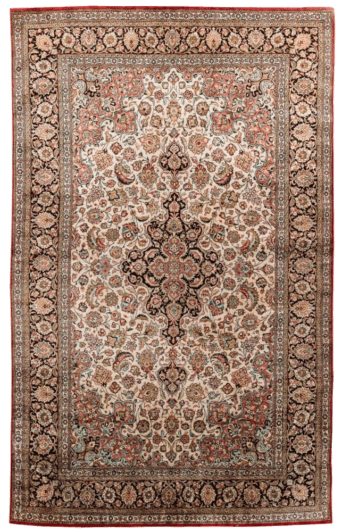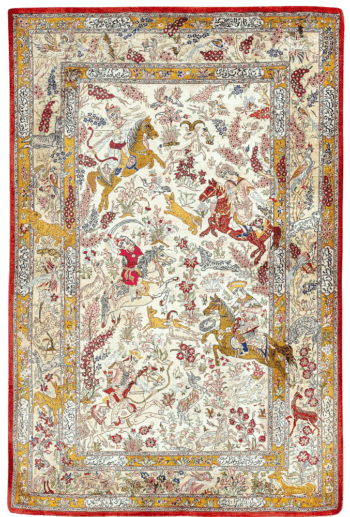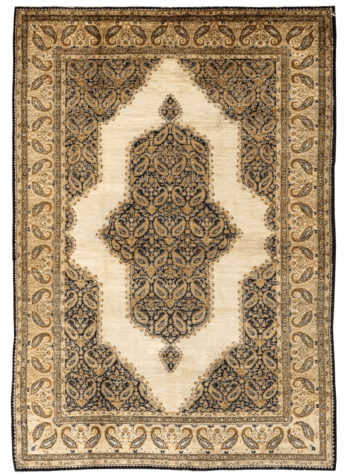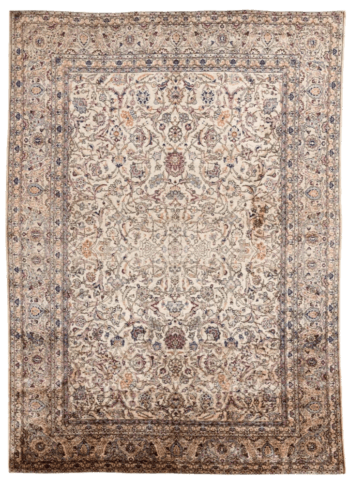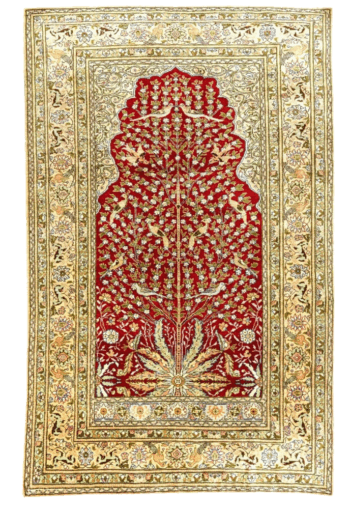
Silk rugs, considered the epitome of luxury, have a fascinating history. Silk textile production originated in China, but it was during the Sassanid Empire (3rd – 7th centuries) in Persia that silk fabric manufacturing flourished. It’s unclear whether China or Persia initiated silk rug production.
The oldest handmade silk rugs are Persian, from the Safavid Period. Over time, regions producing oriental rugs – Persia, Turkey, Turkestan, Tibet, and China – began crafting rugs entirely or partially from silk. The finest silk rugs have both their pile and base (the weft and warp fringes) made of silk. Silk’s delicate texture, reflective and luminous properties, and the richness and intensity it lends to dyes surpass the finest wool.
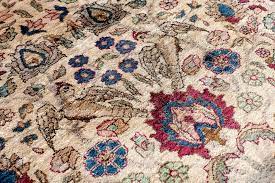
Silk, a thin yet strong fiber, transforms a rug’s appearance, even when the artist used partially to highlight a particular design. Its prismatic structure reflects light, enhancing the colors’ brightness.
Silk’s flexibility and durability, coupled with its intrinsic value and beauty, outshine all other natural and synthetic fibers. As a commodity, it was transported through the most famous trade route in the world and created immortal legends.
Today, silk remains a luxury. Silk rugs, with their unmistakable luminescence, shine, and soft, sumptuous texture, mesmerize. Thinner than human hair, silk fibers refract ambient light, producing a bright, elegant appearance. Despite the tedious process of unwinding thousands of meters of silk from a cocoon, the resulting handmade silk rugs are exceptionally desirable for their incomparable beauty and luxurious appearance.

Explore our collection of antique silk rugs.
The characteristics of a real silk rug: how to identify one
Because the word “silk” carries so much prestige — and so much price — it is also the most abused word in the rug trade. A large share of what is offered as “silk” is in fact art silk: mercerised cotton or viscose (rayon), cellulose fibres dressed up to imitate the real thing. Fortunately, the characteristics of a genuine silk rug can be checked one by one, and none of the tests requires a laboratory.
1. The sheen: real silk changes colour with the light
Silk fibres have a prismatic structure that refracts light. Walk around the rug: seen along the direction of the pile, the colours look deep and saturated; seen against the pile, they turn paler, almost silvery. This shift of colour with every angle is the signature of real silk. Artificial silk shines too, but with a flat, whitish gloss that barely changes as you move. On antique pieces with natural dyes the effect is richer still — see the differences between naturally and synthetically dyed rugs.
2. The touch: silk is warm, imitations are cool
Rub the pile briskly with the palm of your hand. Genuine silk warms up noticeably under friction; viscose and mercerised cotton stay cool and feel limp rather than alive. A fine silk rug is also surprisingly thin and supple — it folds in the hand almost like a scarf, with none of the stiffness of a coarse imitation.
3. Knot density: finer than a human hair
Silk filament is finer than a human hair and extremely strong, which is precisely what makes the astonishing detail of the great silk rugs possible. Turn the rug over and study the back: authentic silk pieces from Qum, Kashan or Hereke commonly exceed half a million knots per square metre, and the drawing remains crisp on the reverse. A “silk” rug with coarse, widely spaced knots contradicts the very reason silk is used.
4. The fringe: the skeleton of the rug, not a decoration
In a true silk rug the fringes are the ends of the warp — the rug’s skeleton — and in the best pieces that foundation is itself silk. If a gleaming “silk” pile sits on plain cotton warps, or worse, if the fringe is sewn on, be suspicious: viscose pile on a cotton foundation is the classic construction of the tourist-market imitation.
5. The burn test: the last resort
Dealers settle arguments with a single loose thread from the fringe — never from the pile, and only with a strand that is already detached. Real silk, a protein fibre like hair, burns slowly, smells of burnt hair and leaves a brittle black ash that crumbles between the fingers. Cellulose imitations smell of burning paper and leave a soft grey ash that keeps glowing. One thread is enough to end the discussion.
Why a real silk rug is worth more
Silk enters a rug at three levels, and each level raises the ambition of the piece: a wool rug with silk highlights, a rug whose entire pile is silk and, finally, silk-on-silk, in which warp and weft are silk as well — the construction of the finest Qum and Hereke work. The material itself is costly (thousands of cocoons are unwound for a single kilogram of filament), the knotting is at least twice as slow as comparable work in wool, and only experienced masters are trusted with it. That is why authenticity weighs so heavily on the price: the tests above protect the buyer exactly where the difference in value is greatest. How that value is formed — origin, age, dyes, condition — is the subject of our guide on how the values and prices of rugs are determined, and estimating the age of a piece has its own set of features to check.
Quick answers
How can you tell if a rug is real silk? Check four things together: a sheen that changes colour as you walk around the rug, a pile that warms under a brisk rub of the palm, very fine and dense knotting visible on the back, and fringes that are the silk warp of the rug itself rather than a sewn-on border. In case of doubt, a burn test on one detached fringe thread is definitive: real silk smells of burnt hair and leaves a brittle black ash.
What is “art silk” in rugs? A trade euphemism for artificial silk — mercerised cotton or viscose (rayon). These cellulose fibres imitate the gloss of silk while new, but they shine white instead of shifting colour, feel cool to the touch, wear down quickly and have none of silk’s strength. They are common in bazaar and tourist-market “silk” rugs, notably those of Kayseri.
Are silk rugs more valuable than wool rugs? At comparable quality, yes — the material is costlier, the knotting finer and slower, the result rarer. But quality rules: a masterly antique wool rug is worth far more than a mediocre modern silk one. Origin, age, dyes and condition decide the final value, never the fibre alone.
Silk in the Figalli collection
The collection currently includes three hand-knotted Qum (Ghom) silk rugs from Persia — 100 × 157 cm, 104 × 150 cm and 134 × 215 cm — pieces that pass every test described above with ease: the shifting sheen, the warm touch of the fibre, the minute knotting of true Qum work.
Related reading: Should I Restore My Antique Rug? · Are antique rugs expensive? · Understanding the Rug’s Backside · Ardabil, the most famous carpet in the world · Interpretations of Caucasian rug patterns